Twigface
Type a script and it animates a narrated cartoon clip, drawn entirely from maths.
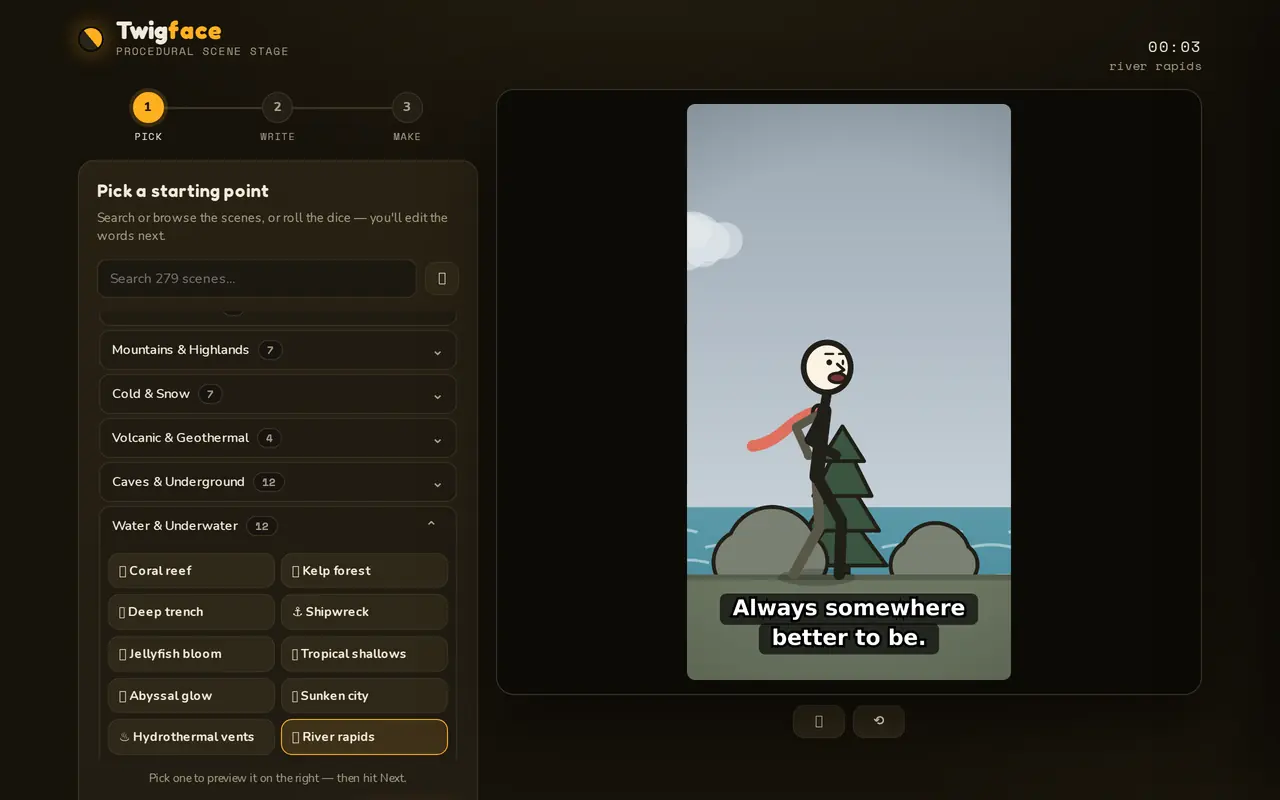
Twigface is a cartoon stage in a browser tab. You type a script — one line per caption — pick one of eighteen scenes, and a stick-limbed character walks, sits, gestures and lip-syncs its way through it. One click records the result as a WebM; a share link reproduces the exact scene, script and camera on someone else's screen. Nothing on screen is a stored image: every frame, from the mountains to the mouth shapes, is drawn at runtime from maths and a seed.
That constraint is the whole point. I wanted to find out how much of a cartoon world could come out of pure geometry with no art files at all, and it turned out to be more than I expected — hats, furniture, weather, walk cycles, rooms. It began as a single-file prototype called Toonwalk, which is still in the repo as the behavioural reference for the engine.
The script doubles as a direction language, on one rule: [square] is how it sounds, {curly} is what the body does. Square brackets are free-form tone passed to Gemini's speech model, so [deadpan], [whispering nervously] and [dawning dread] all land as different performances of the same words. Curly braces drive the rig from a fixed vocabulary — {nod}, {smug}, {point-right}, {facepalm}, {walk-away} — and a button will mark up a plain script for you if you would rather not annotate by hand:
[grand] {proud} Behold — my kingdom.
[deadpan] It is a car park. {point-right} That is a Nissan.
There is a headless renderer too, so the same script goes to MP4 from a command line with no browser involved — which is what turns a toy into something that can produce clips in bulk. It is still a toy first, though: no account, nothing to buy.